Bundling home and auto insurance with one carrier is one of the most reliable discounts in personal insurance — industry research consistently puts typical savings between 10 and 25 percent on premiums. But a discount applied to an overpriced policy can still leave you paying more than two well-shopped standalone policies. Here’s how to tell which situation you’re in.

What bundling actually means
Bundling (or a multi-policy discount) means buying two or more insurance policies from the same carrier — most commonly auto plus homeowners, but also auto plus renters, condo, landlord, umbrella, or even life insurance. The carrier gives you a discount on one or both policies, typically the auto policy, in exchange for more of your business.
It’s not a special product — it’s the same policies you’d buy separately, priced together. The appeal is real: industry research cited by Mercury Insurance in an April 2026 release puts the typical multi-policy discount range at 10 to 25 percent, with bundled policyholders able to save up to 25 percent on premiums (Mercury Insurance via PR Newswire). That’s one of the largest single discounts available on a standard auto policy, which is why it’s the first thing most discount audits check for.
But the discount percentage is only half the story. A 20% discount on a $3,500 policy ($700 off, $2,800 net) loses to a 5% discount on a $2,600 policy ($130 off, $2,470 net). Compare totals, not percentages.
The honest math: what the discount is worth
Let’s ground this in real numbers. Experian’s August 2026 analysis puts the national average full-coverage auto premium at $2,922 per year, with minimum coverage averaging $1,580 (Experian). As an illustration, here’s what a 10–25% bundling discount range means against that average:
| Auto premium (full coverage) | 10% bundle discount | 25% bundle discount |
|---|---|---|
| $2,922 (national avg, Experian) | ≈ $292/yr | ≈ $731/yr |
| $2,000 (below-average driver) | ≈ $200/yr | ≈ $500/yr |
| $4,000 (high-risk / expensive state) | ≈ $400/yr | ≈ $1,000/yr |
These are illustrations, not quotes — your base premium depends on your state, vehicle, driving record, and the carrier’s own rating. The point is the range: bundling is usually worth a few hundred dollars a year, which is meaningful but not transformative. It’s also worth noting the discount typically applies to the auto side (and sometimes the home side too), so the total household savings can be larger than the auto figure alone.
One more piece of math people miss: discounts stack. A bundling discount combines with safe-driver, pay-in-full, paperless, and other discounts — though insurers apply them sequentially against the shrinking premium, so two 10% discounts save 19%, not 20%.
When bundling genuinely wins
- The carrier is already competitive on both lines. If your auto insurer’s homeowners quote is in the same ballpark as the best standalone home quotes, the bundle discount is pure savings on top.
- You want one relationship. One renewal date, one bill, one point of contact. Mercury’s analysis highlights a less-discussed benefit: aligned deductibles and limits across home and auto reduce coverage gaps, and a single carrier can coordinate when one event (say, a storm) damages both your house and your car (Mercury Insurance via PR Newswire).
- You’re a renter, not a homeowner. Renters insurance is cheap, and many carriers extend a meaningful multi-policy discount to auto-plus-renters bundles — often the highest return per dollar of premium in insurance.
- You value retention perks. Bundled customers are stickier, and insurers know it — which can translate into better treatment at renewal and fewer non-renewal surprises. (J.D. Power’s 2026 outlook found only 51% of high-value multi-product customers would “definitely” renew, showing even loyal customers are shopping now — loyalty only pays if the price stays competitive.)
When bundling loses (or breaks even)
The honest cases where bundling isn’t the answer:
- One line is badly overpriced. This is the big one. A carrier that’s great on auto but expensive on home (or vice versa) can absorb the whole discount and then some. Always get the bundle quote and standalone quotes for each line.
- You’re comparing against specialists. Some carriers dominate a niche — a regional insurer might be unbeatable on auto in your state while a national carrier wins on home. Two specialists can beat one generalist even after the bundle discount.
- The discount is small for your situation. Multi-policy discounts vary by state and carrier. In some cases the actual discount is closer to 5% than 25% — not nothing, but not a reason to stay with an overpriced carrier.
- You might cancel one policy. Selling the house, moving to a rental, or switching one line mid-term can vaporize the discount on the remaining policy. If your living situation is in flux, lock in good standalone rates first.
- Loyalty complacency. Bundled customers shop less, and insurers’ pricing models know that. A bundle that was competitive three years ago may not be today. The NAIC recommends checking your policies once a year to make sure the coverage still fits and you’re still getting a good deal (NAIC) — and 2025 was a record shopping year, with 57% of auto customers comparing policies according to J.D. Power.
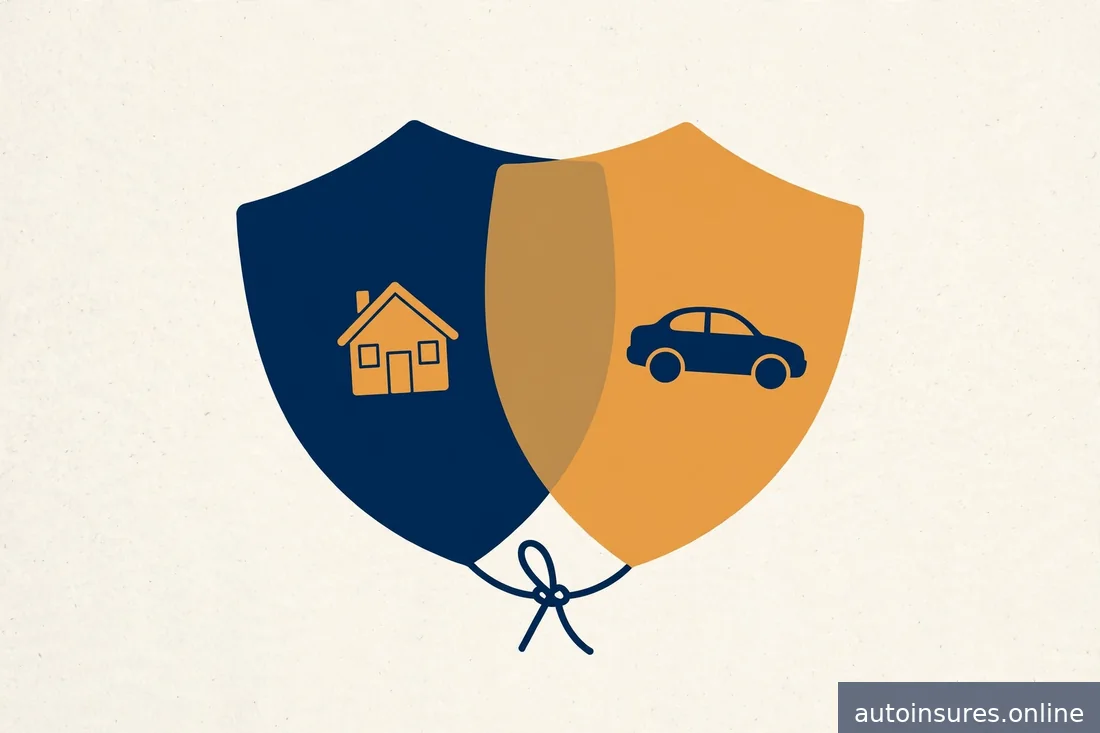
The renters bundle: the easiest win in insurance
If you rent rather than own, bundling deserves special attention — because the math is unusually favorable. A renters policy is one of the cheapest insurance products that exists, yet pairing it with your auto policy at the same carrier typically unlocks a multi-policy discount on the auto side worth far more than the renters premium itself.
Consider the shape of the deal: industry analyses put typical bundling savings at 10–25% of premiums, and on a $2,000-a-year auto policy that’s $200–$500 a year back. A renters policy commonly costs a fraction of that. Even before counting the renters coverage itself — protection for your belongings against theft, fire, and water damage, plus personal liability if someone is injured in your apartment — the auto discount alone usually pays for the renters policy several times over.
There are a couple of caveats worth knowing. First, the discount applies to the auto premium in most carrier programs, so confirm how your carrier structures it before assuming both lines get cheaper. Second, renters bundling still follows the same rule as homeowners bundling: compare the total — bundled auto-plus-renters versus the best standalone auto plus the best standalone renters. In the vast majority of cases the bundle wins, but the five minutes of comparison shopping is what turns “probably” into “certainly.”
If you’re a renter who has never bundled, this is the single highest-return phone call in personal insurance: one call to your auto insurer asking for a renters quote and the multi-policy discount, and you’ll know within minutes whether you’re leaving money on the table.
How to test a bundle properly
Do this at renewal (or when adding a home/renters policy) and you’ll never have to guess:
- Get the bundle quote from your current carrier with identical coverage limits and deductibles on both policies.
- Get standalone quotes for each line from at least two other carriers — again with matching limits and deductibles. The NAIC’s guidance on comparing quotes stresses that coverages must match quote-to-quote, or the comparison is meaningless (NAIC).
- Compare household totals, not just the auto line. Include the home policy’s price in the math.
- Check the discount’s conditions. Does it apply to both policies or just auto? Does it survive if you drop one policy? Is there a loyalty tier that increases it over time?
- Look beyond price. Check complaint ratios with your state insurance department before switching — the NAIC recommends this explicitly, since the cheapest quote isn’t always the best value (NAIC).
If the bundle wins on total price with comparable service, take it — and re-run this test every year or two. If it doesn’t, there’s no shame in splitting your policies. Our guide to switching car insurance covers how to move the auto line without a coverage gap, and the full discount audit walks through every other discount worth checking.
- Bundling typically saves 10–25% on premiums — real money, usually a few hundred dollars a year, but not life-changing.
- Compare household totals, not discount percentages: a big discount on an overpriced policy can still lose.
- Renters bundling is often the best value per dollar; homeowners should still get standalone quotes for each line.
- Re-test the bundle annually — loyalty complacency is how competitive bundles quietly become expensive ones.
Frequently asked questions
Do I have to bundle home and auto with the same agent?
No — you need the same carrier (insurance company) for the multi-policy discount, not necessarily the same agent. Two agents selling the same carrier’s products can both write your bundle.
Does bundling renters and auto work the same way?
Broadly, yes — most carriers offer a multi-policy discount for auto plus renters insurance. Because renters policies are inexpensive, the discount is almost always worth more than the renters premium itself, making this one of the easiest wins in personal insurance.
Will I lose my bundle discount if I file a claim?
Filing a claim doesn’t remove the discount — the discount is for holding multiple policies, not for being claim-free. A claim can affect your premium through surcharges or lost claim-free discounts, which is a separate mechanism. See what affects car insurance rates for the full picture.
Can I bundle if my home and auto renew at different times?
Yes. You can start the second policy mid-term on the first; the discount typically applies from the date both are active. Just make sure the new policy’s start date leaves no coverage gap on either line.
This is general information, not financial advice — check your state’s insurance department for rules that apply to you.