The moments after a crash are stressful, but a short list of calm steps — secure the scene, document everything, exchange information carefully, notify your insurer, and avoid admitting fault — protects both your safety and your claim. This guide walks through each step in order.
At the scene: safety first
Before thinking about insurance, handle the immediate priorities in this order:
- Check for injuries. Call 911 if anyone is hurt — even slightly. Many injuries, including whiplash and concussions, reveal themselves hours later, and a medical record created close to the crash is valuable if a claim follows.
- Move to safety if you can. If the cars are drivable and the crash is minor, move them out of traffic to the shoulder or a nearby parking area. If a vehicle can’t move, turn on hazard lights and stay clear of traffic.
- Call the police. Even for minor crashes, a police report creates an official record of what happened, who was involved, and the conditions at the scene. Some states require reporting crashes that cause injury or property damage above a threshold — ask the officer or check your state insurance department’s guidance.
Never leave the scene of a crash until it’s appropriate to do so. Leaving can be treated as a hit-and-run in many states, which carries serious penalties and complicates any insurance claim.
What to document before you leave
Once everyone is safe, documentation becomes your most important job. Insurers and adjusters settle claims based on evidence, not memories, and memories fade fast. Collect as much of the following as you can:
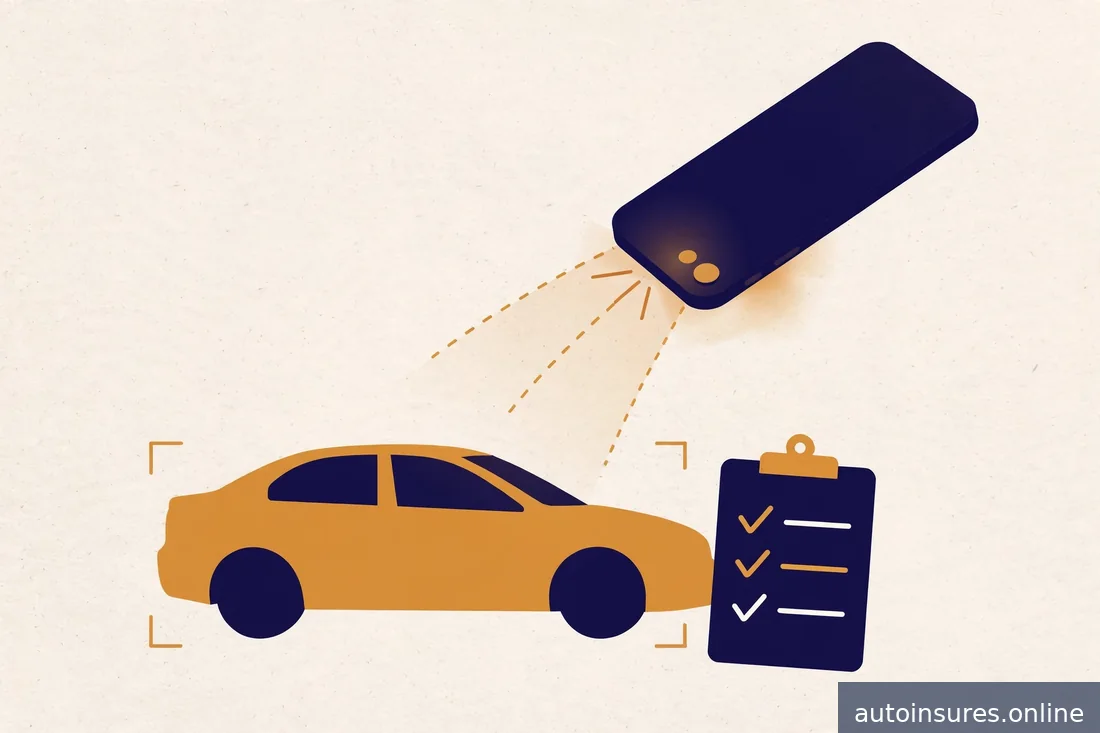
- Photos and video of everything. All vehicles from multiple angles, close-ups of damage, the full scene (road, traffic signals, lane markings, weather, skid marks), license plates, and any visible injuries. Take wide shots that show vehicle positions and tight shots of damage.
- The exact location and time. Note the street, direction of travel, and what happened in sequence while it’s fresh.
- Witness names and contact details. Independent witnesses can matter enormously if fault is disputed later.
- The police report number and the responding officer’s name and department, so you can request the report later.
The Texas Department of Insurance advises drivers to gather their policy information and the details of the other driver, and notes that in that state drivers have the right to choose their own repair shop and parts — an insurer can’t dictate which shop you use. Checking your own state’s consumer bill of rights is a good early step after any crash, because these rights vary by state (Texas Department of Insurance consumer bill of rights via InsuranceNewsNet).
Exchanging information: what to share (and not)
You need the other driver’s name, contact information, insurance details (company and policy number), and vehicle registration. You should share the same information about yourself. A few cautions apply:
- Don’t share your driver’s license number with the other driver. The NAIC notes that in the hands of criminals, your license number can be as valuable as cash, and it is the most common way to confirm identity after Social Security number and date of birth. Exchange insurance information — not license numbers or other sensitive identifiers (NAIC Consumer Auto).
- Don’t discuss fault. Avoid saying “I’m sorry” or “it was my fault,” even as a courtesy. Determining fault is the insurers’ job, based on evidence. Stick to exchanging facts.
- Don’t negotiate on the spot. An offer to “just pay for it myself” from the other driver may sound tempting after a fender bender, but it leaves you exposed if damage or injuries turn out to be worse than they look.
If the other driver is uninsured or flees the scene, note whatever you can — vehicle description, partial plate, direction of travel — and tell the police. Uninsured motorist coverage on your own policy exists for exactly this situation, as explained in our guide to uninsured motorist coverage.
Notifying your insurer
Contact your insurance company as soon as practical — ideally the same day. Most policies require “prompt” or “timely” notification, and delays can give an insurer grounds to question or complicate the claim. Here’s how to handle the call:
- Stick to facts. Describe what happened, where, when, and who was involved. You don’t need to volunteer opinions about fault or speculate about causes.
- Give complete driver information. The NAIC warns that failing to include all drivers in your quote or policy can cause real problems: if an unnamed household driver causes an accident, the company could cancel or non-renew your coverage or charge additional premiums (NAIC on comparing quotes). If you recently added a driver — see our guide to car insurance for teens — make sure your policy reflects that.
- Ask what happens next. The insurer will assign a claim number and an adjuster. Ask for the claim number, the adjuster’s name and direct contact, and the expected timeline.
- Ask about rental and towing coverage. If your car isn’t drivable, ask whether your policy includes rental reimbursement or towing. Don’t assume it does — these are usually optional endorsements.
If you were driving someone else’s car (or someone was driving yours), permissions matter: almost all liability policies cover a licensed driver who drives your car with your permission, according to the NAIC — though some policies specifically exclude other drivers, so check your declarations page (NAIC Consumer Auto).
What not to say or sign
After the initial notification, be careful with these common missteps:
- Don’t give a recorded statement to the other driver’s insurer without understanding what it will be used for. You’re not obligated to make their investigation easy. Many drivers in this situation consult their own insurer or an attorney first.
- Don’t accept a quick settlement or sign a release before you know the full extent of damage and injuries. Once you sign a release, you generally can’t come back for more, even if new problems appear.
- Don’t post about the crash on social media. Photos of you hiking the day after you claimed a back injury are the classic example, but even innocent posts can be misused.
- Don’t repair the car before the adjuster sees it. Insurers typically want to inspect damage first — or at least receive photos and estimates — before authorizing repairs.
How the claim process unfolds
After you report the crash, the claim generally follows this path:
- Claim opened, adjuster assigned. Your insurer investigates: police report, photos, statements, and vehicle inspections.
- Fault determined. In most states, the at-fault driver’s liability insurance pays for the other party’s damage and injuries. Your own collision coverage pays for your car’s damage regardless of fault (minus your deductible).
- Estimates and repair. The adjuster evaluates repair costs. Remember: the insurer generally pays for the repair itself, but you’re typically free to choose where the work is done — Texas’s bill of rights explicitly protects that choice, and many other states have similar provisions.
- Settlement. For injuries, settlements can take weeks to months, since the full extent of medical costs needs to be known. For vehicle damage alone, it’s usually faster.
Some useful context on what insurers pay out: the Insurance Information Institute reports that in 2024, the average auto liability claim for property damage was $6,770 and the average bodily injury claim was $28,278, while the average collision claim was $5,489 — a reminder that even “minor” crashes carry real costs (Triple-I facts and statistics).
| Claim type | What it pays for | 2024 average claim (Triple-I/ISO) |
|---|---|---|
| Liability — property damage | Damage you cause to others’ property | $6,770 |
| Liability — bodily injury | Injuries you cause to others | $28,278 |
| Collision | Damage to your own car from a crash | $5,489 |
| Comprehensive | Theft, weather, vandalism, glass | $2,306 |
If your car is declared a total loss, know how the payout is calculated: the insurer pays the car’s actual cash value — what it was actually worth the moment before the crash, based on comparable used cars in your area — not the original purchase price and not necessarily the price you see in an online guide. The NAIC explicitly warns that valuation guides are “only a guide” (NAIC Consumer Auto). Gap insurance exists for the situation where the payout is less than what you still owe — see our explainer on gap insurance.
For a full walkthrough of the filing process from first call to final settlement, see how to file a car insurance claim. And if the crash leaves you wondering whether your coverage limits are right for next time, our comparison of full coverage vs liability walks through the decision framework.
- Secure the scene, call 911 if anyone is hurt, and get a police report — official records protect your claim.
- Photograph everything, collect witness details, and exchange insurance information (not your driver’s license number).
- Notify your insurer promptly with facts only; don’t admit fault or speculate about causes.
- Don’t give recorded statements to the other insurer or sign releases before you know the full picture.
- Total-loss payouts are based on actual cash value, and you generally have the right to choose your repair shop.
Frequently asked questions
Should I file a claim for a minor fender bender?
It depends on the numbers. Compare the repair estimate against your deductible and consider that a claim goes on your claims history, which can affect future premiums. If the damage is barely above your deductible, many drivers consider paying out of pocket — but still document the incident and notify your insurer of the facts.
Can my premium go up if the accident wasn’t my fault?
Possibly. Premium increases are more likely when you’re at fault, but the NAIC notes that an insurer may still have the right to raise premiums after a second not-at-fault accident within a policy period. This is one reason what affects your car insurance rates is worth understanding before you need it.
How long do I have to report the accident to my insurer?
Policies require prompt notification — many say “as soon as practicable.” In practice, same-day or next-day reporting is the norm. Long delays can complicate the claim, so don’t wait weeks.
What if the other driver doesn’t have insurance?
File the claim under your own policy’s uninsured motorist coverage if you have it. More than one in seven U.S. drivers was uninsured in 2023, according to the Insurance Research Council via the Triple-I, so this coverage isn’t a niche add-on — it’s protection against a genuinely common scenario (Triple-I).
This is general information, not financial advice — check your state’s insurance department for rules that apply to you.